Scope 1 — Direct emissions
Emissions from sources owned or controlled by the organization, such as on-site fuel use and relevant process or fugitive emissions.
Understand where an organization’s greenhouse gas emissions arise, how they are estimated and which data is required.
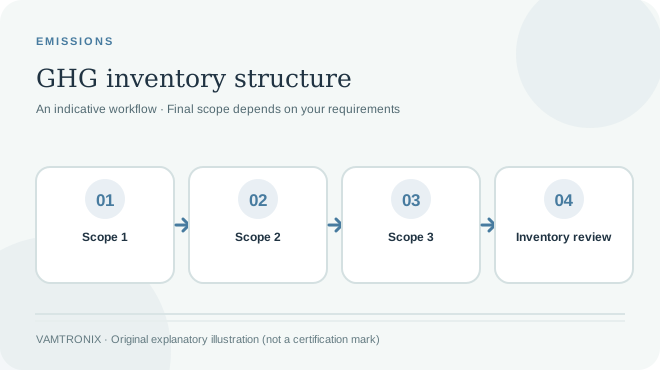
A well-structured inventory begins with organizational boundaries, activity data and a transparent methodology. The GHG Protocol provides widely used guidance for distinguishing direct, purchased-energy and value-chain emissions.
Emissions from sources owned or controlled by the organization, such as on-site fuel use and relevant process or fugitive emissions.
Emissions related to purchased electricity, steam, heating and cooling, with appropriate accounting methods.
Other indirect emissions across relevant upstream and downstream categories, determined through a relevance assessment.
Activity data, factors, assumptions, calculation trails, exclusions and management review records.
Scope and deliverables vary with organization, available information and reporting objectives.
Define reporting entity, operations and base year.
Create an emissions source register and map data owners.
Use documented data, emission factors and methodology.
Identify major contributors and improvement options.
Having basic operational data ready can make an initial discussion more useful.
Guidance for an initial conversation. Always check current scheme or regulatory requirements.
Relevant categories and reporting obligations depend on objectives, materiality and applicable requirements.
No. Initial estimates are useful for planning but do not substitute for a complete, reviewed inventory or independent assurance.
Illustrative consultancy outputs. The final engagement scope and responsibilities are agreed for each project.
Record consolidation approach, organizational boundary, reporting year, source categories and material omissions.
Traceable activity data, factors, global-warming potential sources, assumptions and applicable Scope 2 methodologies.
Identify uncertainty, material Scope 3 screening gaps and high-impact opportunities for future collection or action.
Tell us about your company, reporting objectives and available data.
For accounting methodologies and reference standards: GHG Protocol standards ↗.
VAMTRONIX is an independent advisory service, not the rating or regulatory authority.
Project enquiry
Share enough information for a meaningful first discussion. Fields marked * are required.